In this there is safety, in this there is peace"
What beautiful words from a simple primary song. Recently I read 1 Nephi 3-4 and discovered that there is so much more to that phrase "Keep the Commandments". Indeed these chapters use the phrase or phrases close to it at least 13 times. You know that strange feeling you get when you write or look at a word for so long it looks like it has been misspelled? I felt something akin to that as I read and reread the word "commandment". It was as if I couldn't grasp what the word really meant. I wanted to understand that word better. What is a commandment? Why is it so important to keep it?
Recognizing the two parts of the word, I decided to use my Dictionary.com app to quickly look up the word command and the suffix, -ment. The word 'command' can be a verb or a noun. The act of giving an order or command is the verb (i.e. The general commanded his troops). The specific order is also call a command (i.e. The command was to march). In any case it typically denotes an order given by one who has authority over another and this authority is usually bestowed upon one who deserves and has earned it. It is understood that those who follow such a command would do so out of respect either in a positive light because they want to obey or in negative way out of fearful respect for the power held by the commander.
It would have been just as, if not easier, to say in each case, "Keep the commands of the Lord", "be faithful to the Lord's commands", etc. So it was interesting that they bothered to add -ment at all.
 The suffix, -ment, is placed at the end of a noun to make it concrete and denote an action or resulting state. The addition of this particular suffix adds greater authority. A command-ment is concrete, solid, unchanging and what is more, it implies further that there must be action in response to the command. It is not a request or order that will just go away if we ignore it. The consequences of breaking a command from one holding worldly authority could be quite negligible. Obedience to a commandment from the Lord can be the difference between living spiritually and physically or dying in either respect. In this case Lehi's family and ancestors would need to understand all the commandments of the Lord in order to prosper and grow in the promised land.
Nephi understood this. He knew that every commandment given of God was solid and unchanging and that if not followed negative consequences would result. He recognized God's authority as the ultimate authority and knew that God would fulfill His great and wise purposes in His own way. He respected God's judgement and did strive to keep the commandments out of faith that God knew what was best. Even as it came time to smite Laban lying drunken on the streets of Jerusalem we see Nephi's struggle and also his faith. Could he really break one commandment in order to fulfill another?
There were consequences to murder and they were death. I can imagine Even felt much the same way. The consequence for eating the forbidden fruit was also death. For Eve, knowledge, family, and eternal progression for all mankind were on the line. Nephi's situation wasn't much different as his family faced going to a new land without a full record of the laws and commands they were to follow. Such a loss would likely ruin any chance of progression for Nephi's future family. Nephi was thus commanded by the same creator of the law against killing to kill in order that future generations might live spiritually, knowing the law and keeping it. This is the reason the Spirit tells Nephi, "It is better that one man should perish than that a nation shall dwindle and perish in unbelief." (1 Nephi 4:13) Nephi's faith in the Lord's purposes led him to be able to that which was necessary for the greater good.
This anecdote brings in the theme of sacrifice that is tied to keeping the commandments we are given. We must make sacrifices as ordered by the Lord that we and others may grow and improve. "Adam fell that men might be and men are that they might have joy." (2 Nephi 2:25), Christ suffered all that we might live again, parents give up money, comfort, and time to raise children. In all the cases I can think of the commandments require us to give up something we enjoy for the betterment of ourselves and others. The key to motivating ourselves to willingly keep commandments is to be as Nephi. We must:
- Recognize the authority from which the commandment comes
- Decide the level of respect we have for that authority
- Have faith in the promises that authority has made to us
- Act, even when we can't see to what the action may lead
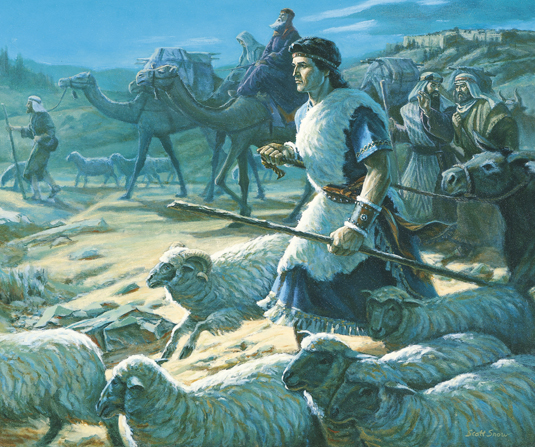 Nephi said, "I will go and do the things which the Lord hath commanded, for I know that the Lord giveth no commandments unto the children of men, save he shall prepare a way for them that they may accomplish the thing which he commandeth them." (1 Nephi 3:7)
He also stated, "...let us be faithful in keeping the commandments of the Lord..." (3 Nephi 3:16, 4:1) and, "Surely the Lord hath commanded us to do this thing; and shall we not be diligent in keeping the commandments of the Lord?..." Nephi was willing to sacrifice all because he had faith in the consequences of obeying the commandments of the Lord. He knew that by fulfilling the commandments that he would be given safety and peace. We too will receive that safety and peace as we keep the commandments of the Lord.


